 Vibrational Virtue™
Vibrational Virtue™
Vibrational Virtue™
The Science of Vibration. The Art of Virtue.
A Different Way of Looking at the Whole Person
Sometimes people know something feels off, but they do not know where to start. They may be dealing with low energy, stress, poor sleep, discomfort, changes in how they feel, or simply want a broader look at what may be going on.
Vibrational Virtue™ is a practitioner-based assessment system built from the tradition of radiesthesia. Instead of relying on a machine to produce a report, trained practitioners work through a structured assessment process using observation, guided questions, comparison methods, and specialized instruments.
Start with the bigger picture, look more closely where needed, document what is found, and give the client something they can actually understand.
The DYL Method™ has spent years helping people detox, rebalance, and reconnect with their bodies. Vibrational Virtue™ is how that work is carried out hands-on — through a Commission of trained practitioners who use a structured, repeatable assessment process instead of guesswork.
Radiesthesia is the foundation behind Vibrational Virtue™ — a practice that uses the human body together with instruments such as pendulums, charts, scales, and other reference tools to look for patterns of response and resonance. Vibrational Virtue™ takes those basic ideas and puts them into an organized system. Practitioners are trained to follow a set process rather than simply asking random questions or giving an unstructured reading.
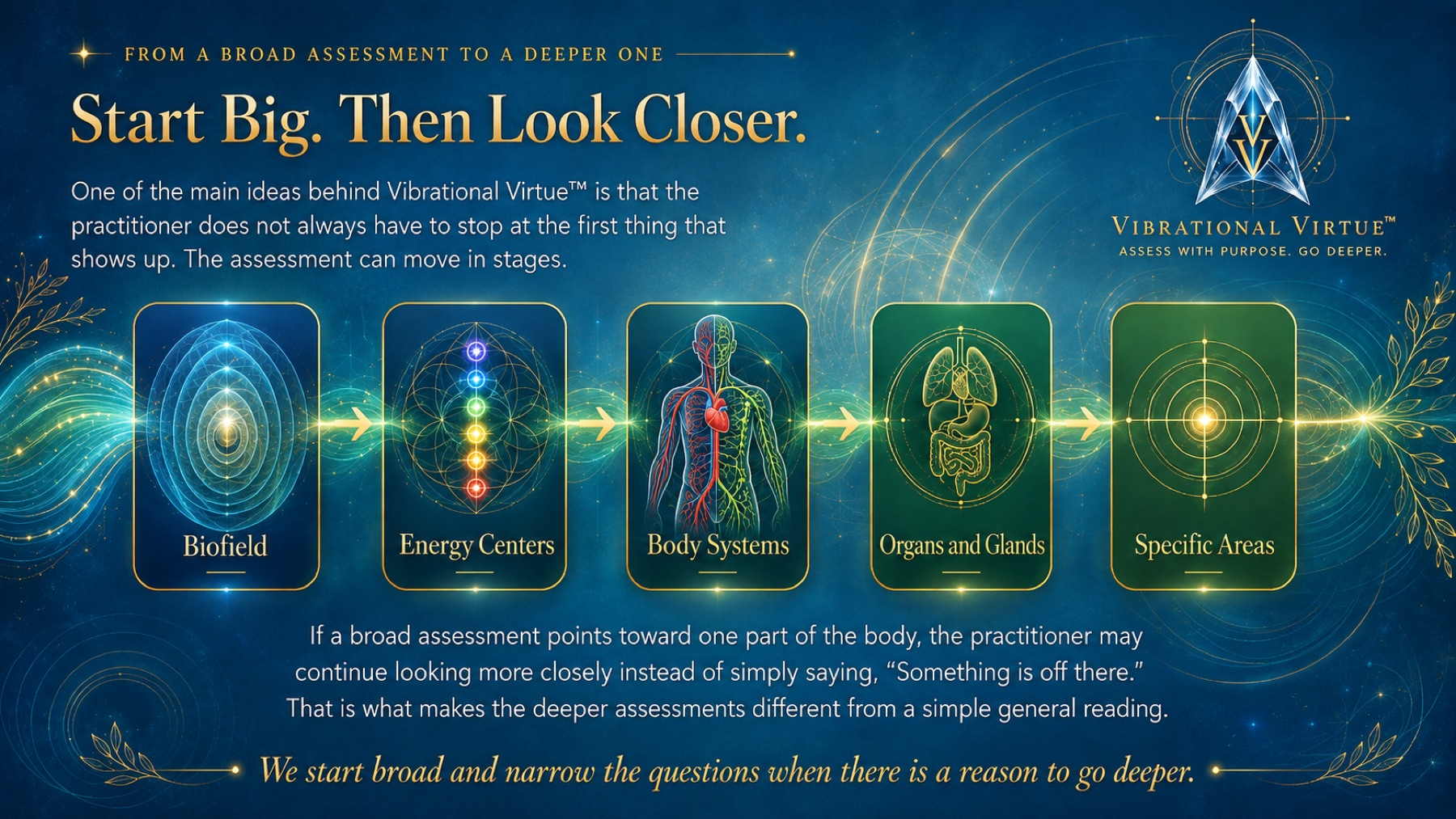
Depending on the assessment, a practitioner may look at the overall energetic picture, major energy centers, body systems, organs and glands, specific areas of the body, environmental factors, possible supportive options, and changes from one assessment to another.
Radiesthesia is the broader practice. Vibrational Virtue™ is the method we use to organize and carry out the assessment.
A meaningful assessment requires judgment, discipline, and careful interpretation. The practitioner must know where to begin, what deserves a closer look, how to narrow the inquiry, and when a finding should be checked again.
Vibrational Virtue™ practitioners are trained to work systematically rather than stopping at the first response that appears. Findings can be compared, questioned, narrowed, and reassessed when necessary to build a clearer overall picture.
Just as important is neutrality. Practitioners train to recognize when expectation, assumption, or personal interpretation could influence the process and to return to structured assessment instead.
This is why training and repeated practice matter. The value of the assessment is not simply receiving an answer — it is having a practitioner who knows how to investigate what appears, determine its significance, and know when to look deeper.
A Vibrational Virtue™ assessment can be done without the client being physically present with the practitioner. For remote work, the practitioner uses what is traditionally called a witness — something used to represent the person, place, or subject being assessed. Depending on the assessment, that may include something such as a photograph, signature, or another approved reference.
The witness gives the practitioner a clear point of focus for the assessment. It does not replace the person — it is used as part of the traditional radiesthesia process for remote work.
Not every assessment looks at everything. The depth depends on the service you choose and what is being investigated.
A broad look at the energetic field around the person and whether certain areas appear stronger, weaker, balanced, or worth looking at more closely.
An assessment of the major energy centers and how they appear to be functioning in relation to one another.
A broader look at major systems of the body to see whether any areas stand out for further assessment.
A deeper look at individual organs and glands when the assessment includes that level of detail.
The practitioner may look more closely at certain areas or structures when there is a reason to investigate further.
Some assessments may include the client's surroundings and whether certain environmental influences appear relevant to the findings.
The practitioner may compare possible supportive options — lifestyle support, home practices, or other non-medical options within the scope of the service.
Your first assessment can become a starting point. Later assessments can then be compared with it to see what has changed.
One of the main ideas behind Vibrational Virtue™ is that the practitioner does not always have to stop at the first thing that shows up. The assessment can move in stages.
Vibrational Virtue™ practitioners may use several types of pendular instruments, charts, scales, reference tools, and other assessment aids. You do not need to understand how every tool works in order to receive an assessment. What matters is that the tools do not all do the same thing — some are useful for simple yes-or-no questions, some help compare options, some help estimate degree or strength, and some help narrow down an area being investigated. The practitioner chooses the instrument based on the question being asked.
There is no single tool that is expected to answer everything.
Curious to explore some of these tools for yourself? The DYL Method™ carries a curated selection of energy work tools — the same shop our practitioners draw from.
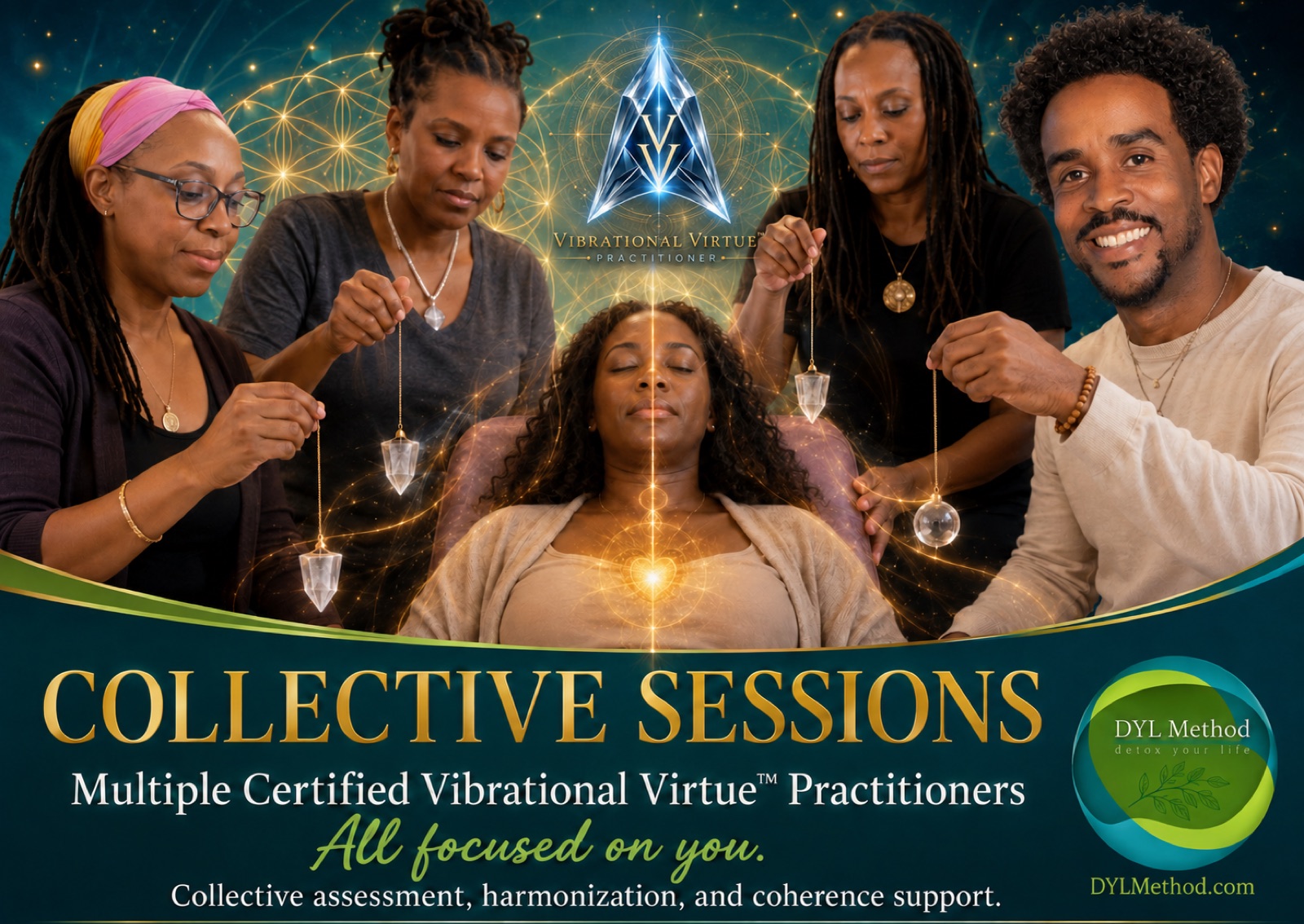
A Group Assessment brings together multiple trained Vibrational Virtue™ practitioners to independently assess the same client.
Each practitioner completes their assessment separately and records their own findings before seeing anyone else's results. The findings are then compared to identify areas of agreement, differences that deserve a closer look, and patterns that may carry greater significance.
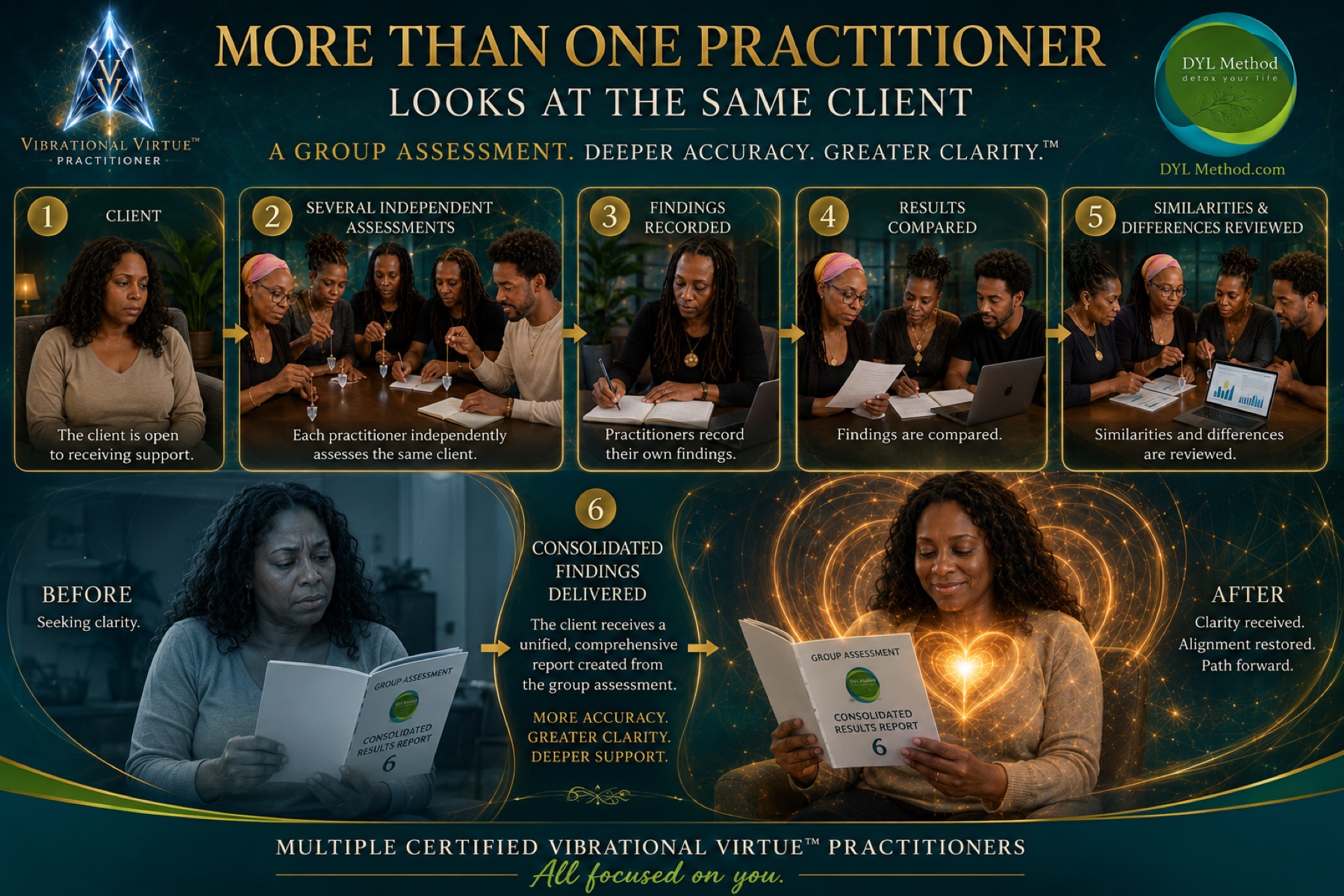
Multiple practitioners evaluate the same client without influencing one another's findings.
Results are compared to identify recurring findings and areas that may require further review.
Different practitioner strengths and sensitivities can reveal patterns that may be less apparent from a single assessment.
The combined review provides a more complete and well-rounded understanding of the findings.
Your results provide a clearer basis for determining appropriate follow-up, harmonization, or additional assessment when indicated.
A Group Assessment brings multiple practitioners into the process so the client's results are not based on a single observation. Each practitioner completes the assessment independently, allowing the findings to be compared for patterns, repetition, and meaningful differences.
When several practitioners identify the same area independently, that repeated finding carries greater significance within the assessment. When findings differ, those differences are also valuable because they can highlight areas that may require closer examination, additional assessment, or follow-up.
A Group Assessment helps to:
The process is intentionally designed so that each practitioner completes and submits their own assessment before seeing anyone else's findings. This preserves the independence of the work and helps prevent practitioners from being influenced by another person's conclusions.
For the practitioner, this creates a powerful learning environment. They are not simply told whether they were "right" or "wrong." They can compare their independent findings against those of other trained practitioners, recognize where patterns consistently converge, identify where their own observations differ, and strengthen their accuracy and consistency through repeated real-world comparison.
For the client, the result is something more substantial than a single assessment: multiple independent observations brought together to identify where the strongest patterns of agreement actually exist.
We are not against technology. Machines, software, imaging tools, laboratory testing, and biofeedback systems can all be useful for the purposes they were designed to serve. Vibrational Virtue™ simply works differently. A machine usually gives information based on the measurements and programming built into that system. A practitioner can change the direction of the assessment as new questions come up.
The point is not that people are better than machines. The point is that a machine is one kind of tool, and a trained person can ask questions that were not already built into the machine.
Your assessment is designed to give you a clear record of the work that was done. What you receive will depend on the assessment you choose.
Your main record showing important information from the assessment and giving us something to compare against in the future.
A clear summary of the main findings from your assessment.
A simple visual breakdown of what was observed in the major energy centers.
A visual summary of the broader energetic findings.
Findings connected with body systems, organs, glands, and specific areas, when included.
Environmental findings organized separately so they are easier to understand.
Which supportive choices appeared to be a stronger or weaker fit during the assessment.
What to pay attention to next, when reassessment may be useful, and appropriate non-medical support recommendations.
For returning clients, new results can be compared against previous assessments. Instead of only asking "What did we find?" we can also ask "What changed?"
Stay connected with Vibrational Virtue™ and The DYL Method™ — hear from our practitioners, learn more about the process, and be the first to know when we share something new. No commitment, no cost.
Not everybody needs the most detailed assessment. Some people want a broad starting point. Others already know they want a deeper look.
For now, every assessment offered is performed by multiple Vibrational Virtue™ practitioners, who independently assess and compare findings before you receive your results.
Several practitioners independently assess the same client, then compare findings for a comparative review. This is the most accurate and thorough option available — many clients choose it as their assessment of choice from the start, not as an afterthought.
How Group Assessments WorkAssessment Only identifies and documents energetic findings and areas of dissonance. Assessment + Harmonization includes the assessment plus practitioner-applied energetic support intended to address identified dissonance and support greater energetic harmony and coherence.
Loading assessment options…
Vibrational Virtue™ did not start with the idea of simply teaching people how to use a pendulum. The method grows out of a much older practice called radiesthesia. For generations, different radiesthesia traditions have used pendular instruments, measurement scales, comparison methods, environmental assessment, and other forms of structured inquiry. Different schools developed different ways of doing the work. Vibrational Virtue™ studies that foundation but uses its own organized system for practitioner training, documentation, comparison, assessment, and follow-up.
We are not asking the public to accept every historical theory connected with radiesthesia as proven fact. We are explaining where the practice comes from and how we apply it today. For us, the important question is practical: can a practitioner be trained to follow a clear process, record what they find, compare their work, and improve their consistency over time? That is what Vibrational Virtue™ is built around.
Living Tradition. Modern Application. Timeless Principles.
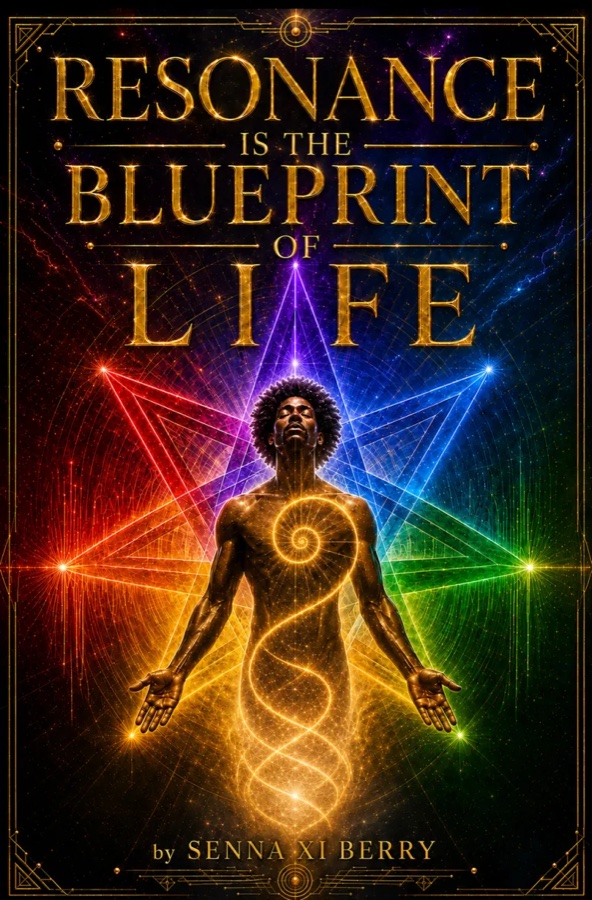
If you would like a deeper understanding of how Vibrational Virtue™ practitioners view the body, energy, and living systems, our founder's book offers a closer look at that outlook.
It is not a medical diagnosis. It does not replace:
Practitioners report what they observe within the Vibrational Virtue™ assessment process. If something needs medical attention, the appropriate next step is medical evaluation. We do not need to pretend an energetic assessment is a medical exam in order for the assessment to have value. They are different things.
The real value of an assessment increases when you have something to compare it with. Your first assessment can create a baseline. A later assessment can show what appears different. Over time, your records can help create a clearer picture of patterns and changes.
See the Larger Pattern. Sometimes the most useful place to start is not with one isolated concern — it is with a broader look at the person. Vibrational Virtue™ gives trained practitioners a structured way to do that.